Data Context
A Data Context is the primary entry point for a Great Expectations (GX) deployment, and it provides the configurations and methods for all supporting GX components.
As the primary entry point for the GX API, the Data Context provides a convenient method for accessing common objects based on untyped input or common defaults. A Data Context also allows you to configure top-level components, and you can use different storage methodologies to back up your Data Context configuration. After you instantiate your DataContext and store its configurations, it always behaves the same way.
Relationships to other objects
Your Data Context provides you with the methods to configure your Stores, plugins, and Data Docs. It also provides the methods needed to create, configure, and access your Data SourcesProvides a standard API for accessing and interacting with data from a wide variety of source systems., ExpectationsA verifiable assertion about data., and CheckpointsThe primary means for validating data in a production deployment of Great Expectations.. In addition, a Data Context helps you manage your MetricsA computed attribute of data such as the mean of a column., Validation ResultsGenerated when data is Validated against an Expectation or Expectation Suite., and the contents of your Data DocsHuman readable documentation generated from Great Expectations metadata detailing Expectations, Validation Results, etc. .
Use Cases
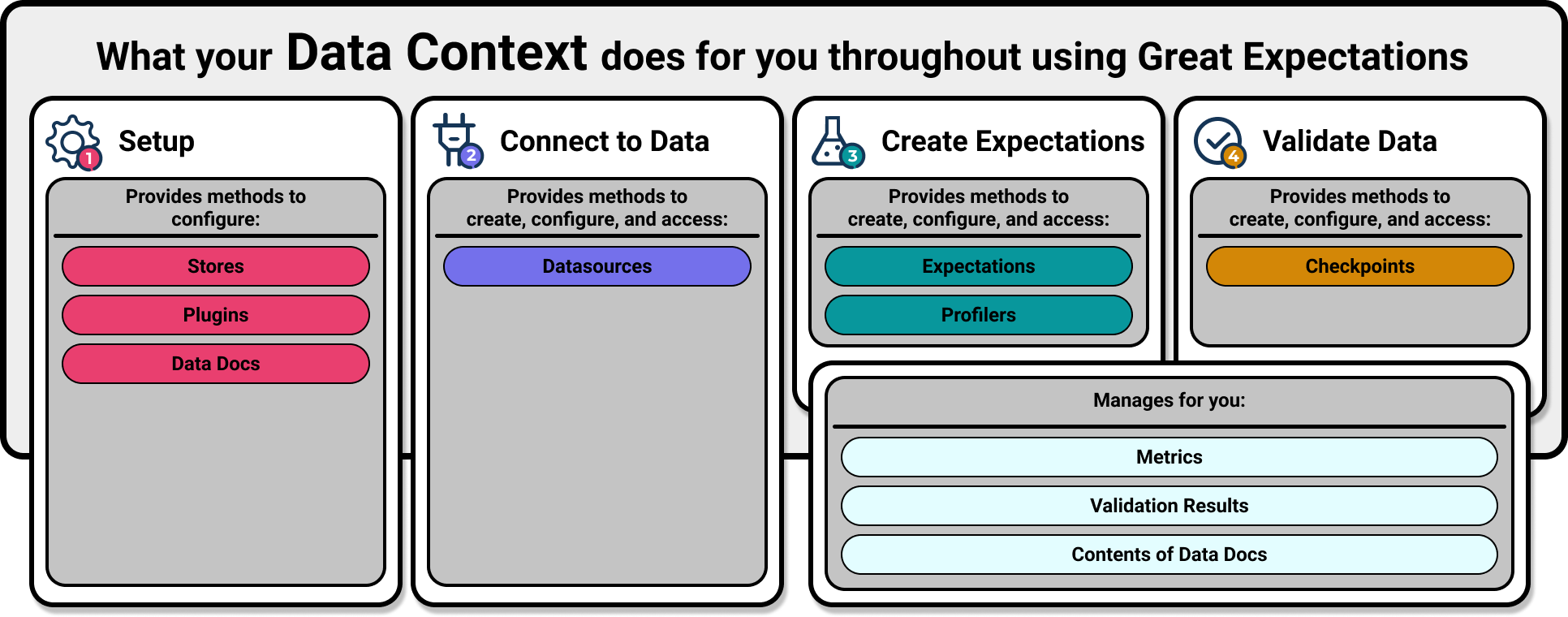
When you configure your GX environment, you'll instantiate a Data Context. See Instantiate a Data Context.
You can also use the Data Context to manage optional configurations for your Stores, Plugins, and Data Docs. To configure Stores, see Configure your GX environment. To host and share Data Docs, see Host and share Data Docs.
When you connect to data, you use your Data Context to create and configure Data Sources. For more information on how to create and configure Data Sources, see Connect to a Data Source.
When creating Expectations, you'll use your Data Context to create Expectation SuitesA collection of verifiable assertions about data. and Expectations, and then save them to an Expectations StoreA connector to store and retrieve information about collections of verifiable assertions about data.. The Data Context also manages Metrics and Validation Results. The Data Context manages the content of your Data Docs (displaying such things as the Validation Results and Expectations). For more information about creating Expectations, see Create Expectations.
When Validating data, the Data Context provides your entry point for creating, configuring, saving, and accessing Checkpoints. For more information on using your Data Context to create a Checkpoint, see Validate Data.
Access to APIs
The Data Context provides a primary entry point to the GX API. Your Data Context provides a convenient method for accessing common objects. While internal workflows of GX are strongly typed, the convenience methods available from the Data Context are exceptions, allowing access based on untyped input or common defaults.
Configuration management
A Data Context includes basic create, read, update, and delete (CRUD) operations for the core components of a GX deployment. This includes Data Sources, Expectation Suites, and Checkpoints. In addition, a Data Context allows you to access and integrate Data Docs, Stores, Plugins, and so on.
Component management and config storage
The Data Context helps you create components such as Data Sources, Checkpoints, and Expectation Suites and manage where the information about those components is stored.
For production deployments, you will want to define these components according to your Data Source and production environment. This may include storing information about those components in something other than your local environment. To view implementation examples for specific environments and Data Sources, see Integrations.
GX Cloud compatibility
Because your Data Context contains the entirety of your GX project, GX Cloud can reference it to permit seamless upgrading from open source GX to GX Cloud.
Instantiating a Data Context
After you've created a Data Context, you'll likely start future work by instantiating a DataContext in Python. For example:
import great_expectations as gx
context = gx.get_context()
Alternatively, you can use the context_root_dir parameter if you want to specify a specific directory
If you’re using GX Cloud, you set up the cloud environment variables before calling get_context.
Untyped inputs
The code standards for GX strive for strongly typed inputs. However, the Data Context's convenience functions are a noted exception to this standard. For example, to get a Batch with typed input, you run the following code:
from great_expectations.core.batch import BatchRequest, RuntimeBatchRequest
batch = context.get_batch_list(batch_request=batch_request)[0]
If you prefer untyped inputs, you run code similar to the following examples:
data_asset_name = "<your_data_asset_name>"
context.get_batch_list(
    datasource_name="taxi_datasource",
    data_connector_name="default_inferred_data_connector_name",
    data_asset_name=data_asset_name,
)
In the example code, the get_batch() method is responsible for inferring your intended types, and passing it through to the correct internal methods.
This distinction between untyped and typed inputs reflects an important architectural decision within the GX codebase. Internal workflows are strongly typed, but exceptions are allowed for a handful of convenience methods on the DataContext.
Stronger type-checking allows the building of cleaner code, with stronger guarantees and a better understanding of error states. It also allows GX to take advantage of tools such as static type checkers, cyclometric complexity analysis, and so on.
Requiring typed inputs can make getting started with GX challenging. For example, the first method shown in the previous code examples can be intimidating if you don't know what a BatchRequest is. It also requires you to know that a Batch Request is imported from great_expectations.core.batch. Allowing untyped inputs makes it possible to get started with GX much more quickly. However, there is always a risk is that untyped inputs will lead to confusion. To reduce or eliminate the risk, GX uses these guidleines:
-
Type inference is conservative. If inferring types require guessing, the method returns an error.
-
Informative errors are provided to help you determine an alternative input that does not require guessing to infer.